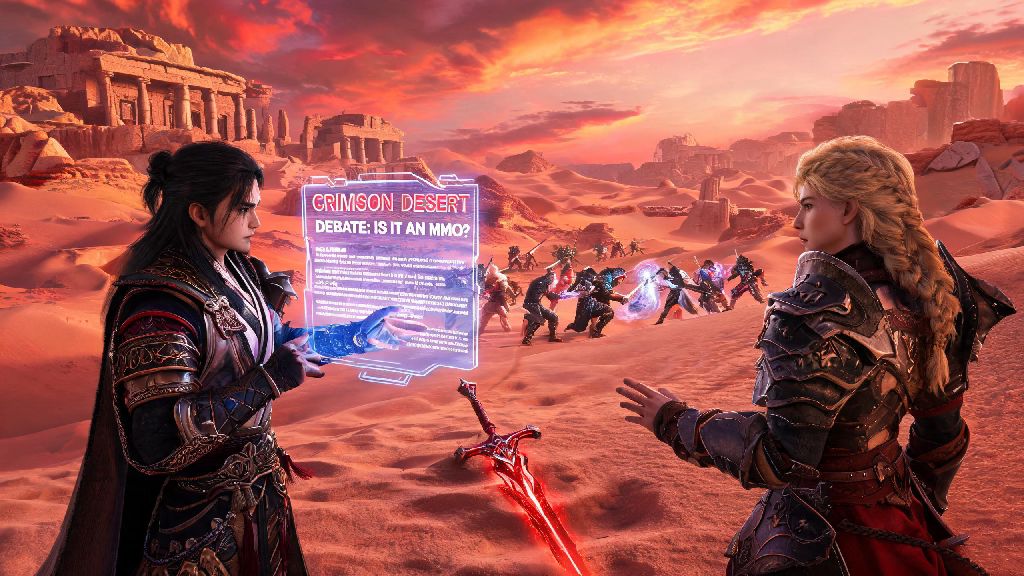
If you’ve scrolled through gaming forums or watched upcoming RPG trailers lately, you’ve almost certainly stumbled on the heated debate around crimson desert mmo or not. As someone who’s tested the closed beta and followed every dev update for the past two years, I can tell you the answer isn’t as black and white as many players make it out to be. A lot of confusion comes from Pearl Abyss shifting its initial design goals halfway through development, so a lot of old info online is no longer accurate. We’re going to cut through the noise to give you a clear, up-to-date breakdown of what Crimson Desert actually is, and who it’s made for.
Crimson Desert MMO Or Not? Breaking Down Core Genre Criteria
First, we have to establish what most players and industry experts mean when they call a game an MMO. The standard definition includes a persistent online world that stays active when you log off, hundreds of concurrent shared server players, group-focused endgame content, and shared world systems that impact every player on the server. If you only go by the strictest genre definitions, the answer to crimson desert mmo or not might lean more towards "online RPG", but if you go by modern player standards, it fits firmly in the MMO space.
Persistent shared server worlds are one of the biggest checks in the MMO box for Crimson Desert. Each server hosts up to 1500 concurrent players at any time, and all world spawns, resource nodes, and territory control status update in real time for everyone on the server. If a guild takes over a castle on your server, that change stays until another group fights to take it back, even if you log off for a week.
The main point of contention for many players is the lack of massive 10,000+ player servers you see in older MMOs like World of Warcraft or even Pearl Abyss’s own Black Desert Online. The smaller server size was a deliberate choice to reduce lag during large PvP battles and make the world feel less crowded, but it leads some players to refuse the MMO label entirely.
Key Gameplay Features That Align With MMO Standards
Even with smaller server sizes, Crimson Desert shares most of the core features players expect from a modern MMO. I spent 12 hours in the closed beta running through early game content and endgame previews, and almost every system felt familiar to my years of playing Black Desert Online and Final Fantasy XIV.
Open world shared resource gathering and crafting is another clear MMO staple in Crimson Desert. Rare ore, herb, and wood spawns are shared across all players on the server, so you’ll often find yourself racing other players to get to a high-value node before it’s gone. You can also sell all crafted items and raw resources on the shared auction house, just like in most traditional MMOs.
Cross-server ranked PvP is also fully supported, with seasonal leaderboards and exclusive rewards for top players. You can queue for 1v1, 3v3, and 10v10 PvP matches with players from any server in your region, which is a standard feature for most modern MMOs.
Reasons Many Players Don’t Classify Crimson Desert As A Traditional MMO
It’s not hard to see why the debate exists, because Crimson Desert deviates from traditional MMO design in some pretty big ways. A lot of these differences come from the game’s original design as a single-player open world action RPG, before Pearl Abyss decided to add MMO features two years into development.
The main story campaign is 90% solo playable, with no forced grouping required to complete any main quest line. That’s a huge shift from older MMOs that required you to group up for main story dungeons to progress. You can opt to play the campaign with up to 3 other friends if you want, but it’s entirely optional, and the story is written to be a personal journey for your custom character first and foremost.
Instanced personal content makes up a large portion of endgame too. Your player housing, character-specific side quests, and roguelike challenge dungeons are all instanced, so you won’t run into random other players while you’re completing them. Some players argue that this heavy focus on instanced content means it can’t be a true MMO, even with the shared open world.
I also remember the original 2020 reveal trailer didn’t mention any multiplayer features at all, so a lot of early fans pre-ordered expecting a single-player game similar to The Witcher 3. That initial marketing stuck for a lot of people, and they still refuse to see it as an MMO even after all the multiplayer additions.
Who Should Play Crimson Desert, Regardless Of Genre Label
At the end of the day, the genre label doesn’t matter nearly as much as whether the game is fun for you. I’ve recommended it to both my solo RPG loving friends and my MMO raid group, and both groups found something to enjoy in the beta.
If you’re a solo player who hates forced grouping and toxic MMO communities, you’ll love that you can play almost the entire game without ever interacting with another player if you don’t want to. The skill-based, no-tab-target combat feels more like a souls-like than a slow traditional MMO, so it’s perfect for players who find standard MMO combat boring.
If you’re a diehard MMO fan, you’ll have plenty to do too. The guild siege battles, player driven economy, and raid content are all as deep as any other MMO on the market right now, and the smaller server sizes actually make it easier to build a tight community with other players on your server.
My best tip if you’re on the fence is to wait for the free 10-hour demo that launches alongside the full game. You can test the solo campaign, explore the open world, and even try a small group dungeon before you spend any money, so you can decide for yourself if it fits what you’re looking for.
At the end of the day, the debate around crimson desert mmo or not comes down to how you define the genre personally. If you count any persistent online open world with shared servers and multiplayer endgame as an MMO, then yes, it qualifies. If you only consider games with massive 10k+ player servers and forced group content as true MMOs, then it falls more into the open world online RPG category. No matter which side you land on, Crimson Desert is a polished, content rich game that has something to offer both solo players and MMO fans alike. Don’t let the genre debate stop you from giving it a try if it looks like something you’d enjoy.